How Shabbos Reaches a Family in the Hospital
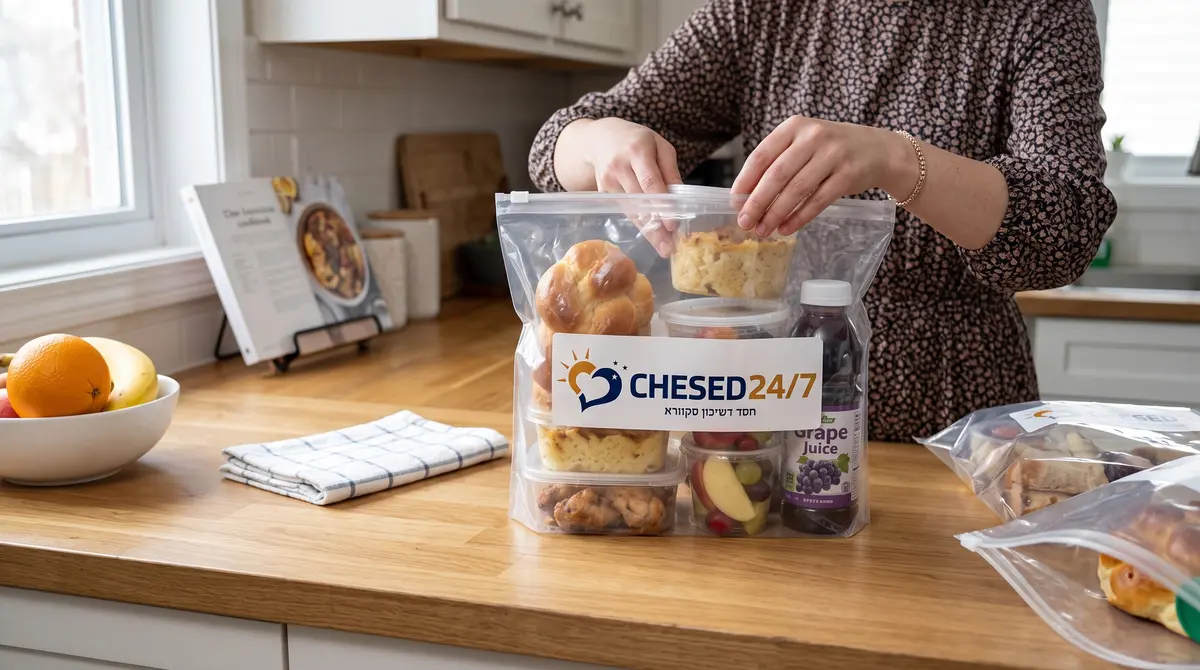
It's a Wednesday morning in Monsey, and one of our longtime volunteers is standing at a kitchen counter with a shopping list she's already checked twice. Chicken thaws in the sink, and a small bowl of dips she started the night before sits within reach. In two days, everything on this counter will be packed into labeled, double-bagged Shabbos meals that leave her driveway on Friday morning and arrive at a hospital bedside by candle-lighting.
She has been doing this for fifteen years. She is one of the home cooks in our Chesed 24/7 volunteer network — a group of women across Monsey and neighboring communities who prepare complete Shabbos meals from their own kitchens each week, alongside the larger warehouse operation in New Square. Their meals reach hospital bedsides across New York and New Jersey, side by side with the Shabbos boxes assembled at the warehouse. Along the way, several other volunteer roles pick each meal up and carry it the rest of the distance.
Tuesday: The Dips
Ask her how a hospital Shabbos begins, and she'll answer without hesitation: "I start shopping on Wednesday. Sometimes dips on Tuesday."
The dips come first because they store well and free up Thursday for cooking. Baba ghanoush, hummus, egg salad. Whatever the family is going to open on Friday night, she'll have it ready by the time the main shopping bags come through the door.
Wednesday: The Shopping
Shopping day is the first day that feels like Shabbos in her kitchen. She buys her family's meals and the hospital family's meals at the same time: pineapple and watermelon, grapes to wash and clean, apples for slow-cooked compote, chicken, onions for kugel, sweet potatoes for a Friday night side, and enough ingredients for three kugels the following day. She'll pick up rugelach on the way through the store, or the flour and chocolate to bake her own.
She doesn't have to send cake, and Chesed 24/7 doesn't require it, but she sends it anyway — homemade or bought, marble or kokosh or rugelach or chocolate. "I like to," she says. "It's Shabbos."
Across Monsey and Spring Valley, other volunteers in the same network are doing the same thing. Some cook two portions a week, some four, some only for Yom Tov. Together they keep a steady supply of home-cooked kosher meals for hospital patients moving toward the drivers who will pick them up on Friday morning.
Thursday: The Cook
Thursday is the cook day. By late afternoon, the kitchen holds Friday night's chicken and chickpeas, sweet carrots, onion kugel, and several kinds of dips, along with three kugels, cold chicken, a fruit salad, and cherry pie readied for Shabbos day. Everything ends up in containers she keeps on hand, labeled with printouts she made once and reuses each week.
The packing, she says, sometimes takes longer than the cooking. She uses double bags so nothing leaks, arranges fresh fruit on top so it doesn't get crushed, and seals cake separately so it doesn't pick up smells.
"I really feel for people in the hospital," she says. "I always ask Hashem that in this zechus, I should stay on the giving end."
The Warehouse Half of Thursday
While she's cooking in Monsey, the New Square warehouse is running its own Thursday operation. Tables are laid out and containers filled with challah, grape juice, candles, gefilte fish, chicken, kugel, and side dishes. A Shabbos in a Box is assembled every few minutes, and by evening dozens are stacked and waiting for Friday's drivers.
"We're doing the same work at the same time," one of our warehouse volunteers said. "It's just that our kitchen is bigger."
The warehouse and the home cooks are two halves of the same operation. When a family calls Chesed 24/7 on a Thursday afternoon, sometimes their Shabbos comes from a warehouse box, sometimes from a home kitchen, sometimes both. The system is built so nobody has to know the difference.
Friday Morning: Pickup
Friday morning, one of our drivers begins his pickup route. He swings through several home kitchens across Monsey and Spring Valley, loading double-bagged Shabbos meals from each one, then stops at the New Square warehouse for a run of boxes. He knows every address on the list and has been to most of them before. His route today may end at a Manhattan hospital, a New Jersey ICU, or a Brooklyn admission that called our office at 9 a.m. Wherever it ends, he has to be off the road before Shabbos.
Friday Afternoon: The Room
By early Friday afternoon, the meals reach the Chesed Room at the hospital. Another set of volunteers — the ones who maintain the rooms — has been there earlier in the week to sweep, restock, and check the coffee bar for the sugar-free packets and the Splenda a caregiver mentioned last month. The shelves hold water bottles, snacks, chargers, wafers, and cleaning supplies for anyone who wants to tidy the room themselves, alongside a map to the nearest shul. Every package on the Shabbos shelf carries a personalized note.
"People don't realize all the ins and outs that go into it," one of our restockers said. "It's not just enough to get by. Every little detail is thought of."
The meals from her Monsey kitchen go on the shelf next to the warehouse Shabbos boxes. From the outside, they look similar. Inside, they are different portions of the same care.
Shabbos Afternoon: The Visit
On Shabbos afternoon, a fourth group of volunteers walks into a Manhattan hospital from Washington Heights. Four young women, twenty minutes each way, doing this together for over three years. They pick up a list from the chaplaincy office, updated even on Shabbos, and start on the floors. This week the list has 25 rooms; last week it had 30.
When they enter a room, they offer to bring food from the Chesed 24/7 shelf, shmooze with the parent by the bed, or play with the little brother sitting next to a sibling with a feeding tube. Then they walk down the hall and start again.
"People so appreciate seeing a Jewish face on Shabbos when they're otherwise in isolation," one of the volunteers said. "You can feel it as soon as you walk in."
Some families they visit have already opened the Shabbos bag. Some haven't found it yet. Some ask, quietly, if there's any way they could get another portion. There usually is.
The Little Things Inside Every Bag
The fruit is fresh, not canned, and every bag holds a piece of cake. Every package also carries a personalized note, handwritten by someone the recipient will never meet. Recipients call back weeks later, sometimes mentioning which label was on the bag, sometimes saying, "I was so hungry, and it did so much for me."
The cooks never learn who received their food. They know only that someone did.
The Rhythm Behind the Meals
By the time a family lights candles on Friday afternoon in a hospital room, five different volunteers in the Chesed 24/7 network have already been part of their Shabbos. Someone shopped and cooked. Someone packed a box at the warehouse. Someone drove. Someone stocked the Chesed Room shelf. Someone will walk the floor tomorrow.
None of them know each other, and none of them will meet the family. But between them, they have assembled something that looks and smells like Shabbos — from a home kitchen, from a warehouse, from a private car, from a Chesed Room shelf. By the time the family opens their bag, it all fits together as if it came from one place.
"You don't know where the steps will take you," one of our longer-serving volunteers put it. "We just do the hishtadlus. Hashem does the rest."
That's how one Shabbos reaches a family in the hospital.
[[cta]]





.svg)