Why Families Stay Close to the Hospital During Medical Crises
Why families choose to stay near the hospital during medical crises — the medical, emotional, and practical reasons — and how 13 furnished Chesed Apartments across NY and NJ make sustained proximity possible.
When a loved one is hospitalized, families often decide that one adult will stay near the hospital for the entire admission — sometimes a few days, sometimes several months. The choice to stay close is rarely simple. It involves real costs: time away from home, time off work, separation from other children, and lodging that is hard to arrange in major hospital cities. The reasons to stay near hospital family members anyway are usually stronger than the obstacles. Chesed 24/7 supports those families through Chesed Apartments and a network of related services.
Why Families Stay Near the Hospital
The decision to stay near the hospital usually comes from a combination of medical, emotional, and practical reasons. Each one alone would be enough. Together, they make staying close the only option that feels right.
Medical Reasons
Treatment plans change quickly. A specialist may visit at unpredictable hours. A surgical decision may need a family member's signature in the middle of the night. A patient who is sedated, intubated, or in pain often cannot speak for themselves, and a family member nearby ensures their preferences and dignity are respected.
In long admissions — NICU stays, oncology treatment, transplant recovery — physical presence in the room or just outside it gives the medical team a reliable contact and gives the patient continuity of care.
Emotional Reasons
Caregiver presence has a released effect on a patient's experience. A familiar face during a long IV infusion. A familiar voice when the patient wakes from anesthesia. A hand to hold during a procedure that the patient finds frightening. These moments accumulate over a long admission, and they are not optional for the families who provide them.
For parents of hospitalized children, presence is a baseline rather than a choice. A child in a hospital wants the parent next to the bed, and the parent wants to be there.
Practical Reasons
Hospital communication is inconsistent. A family member who is physically present catches updates, schedule changes, and instructions that a remote family member would miss. A nurse mentions a discharge plan in passing. A physician explains medication timing while doing rounds. Patient family stress increases when these details get filtered through phone calls or hospital portals — and decreases when someone is there in person.
Family hospital proximity also matters for daily logistics. A bag of clean clothes brought from home. A meal delivered from a kosher restaurant. A short walk to bring back coffee. None of these require an apartment two miles away — but they are far easier when one exists.
What Makes Staying Close Difficult
Families staying close to a patient hospital usually face four practical challenges:
- Lodging cost. Hotels near major Manhattan and tri-state hospitals routinely run $300–$500 per night. A two-week stay quickly becomes financial hardship. A multi-month stay becomes impossible.
- Kosher infrastructure. Most hotel rooms have no kitchen, and few restaurants near hospitals are reliably kosher. A family that keeps kosher is left choosing between expensive deliveries and not eating well.
- Physical exhaustion. Sleeping in a hospital chair, then eating poorly, then doing it again the next day is not sustainable. After a few days, the family member with the patient becomes too exhausted to advocate effectively.
- Distance from other family. A spouse staying close to the patient is not at home with the other children. A solution that lets both parents share the bedside, even alternating days, requires lodging that supports a longer stay.
Without a community-supported option, many families end up choosing between sustainable proximity and financial sustainability. Chesed 24/7 was built so families do not have to make that choice.
How Chesed Apartments Make Staying Close Possible
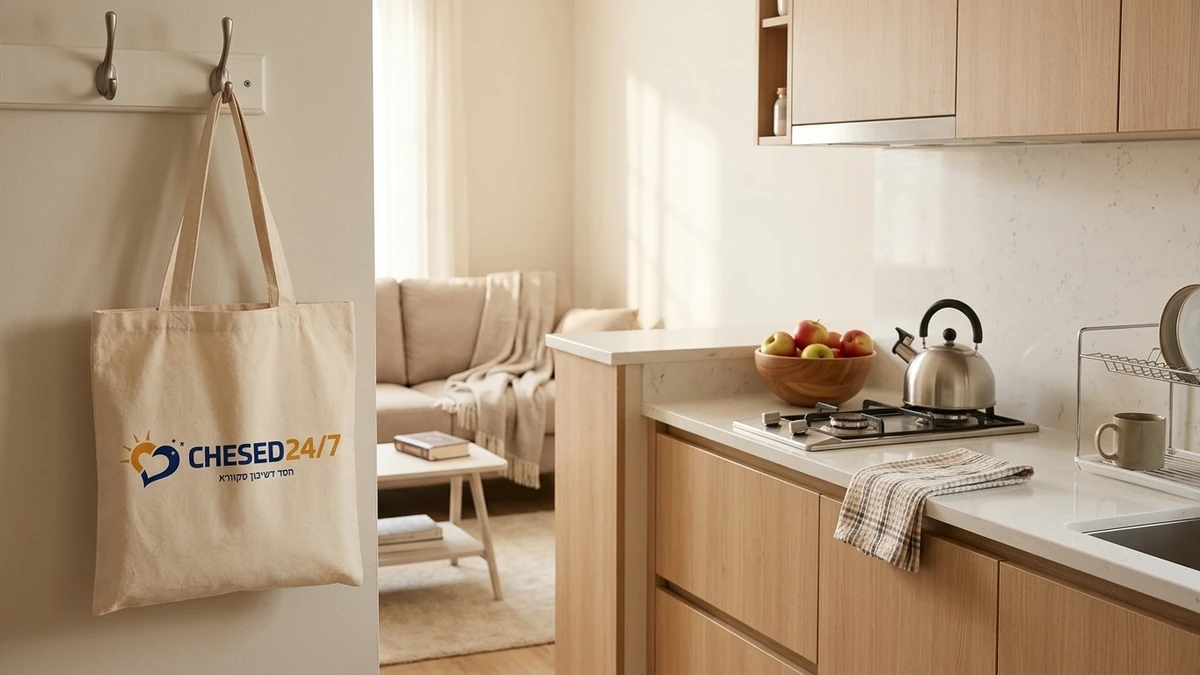
Chesed Apartments are the core service Chesed 24/7 provides for the stay near hospital family situation. There are 13 apartment locations near major Manhattan and tri-state hospitals — including locations near Memorial Sloan Kettering, Mount Sinai Guggenheim, Columbia, NewYork-Presbyterian, and Hospital for Special Surgery. Each apartment is fully furnished and kosher-equipped, cleaned daily, and laundered twice weekly. Configurations include layouts for families, couples, and individual caregivers.
Who Uses the Apartments
- A spouse caring for a patient through a multi-week treatment cycle
- Parents of a child in a NICU or pediatric oncology unit
- A son or daughter staying close to an elderly parent during a surgical recovery
- A family from outside the tri-state area whose patient has been transferred to a Manhattan specialty hospital
How They Work
Apartments are available year-round, 24/7. Stays may last a single night or several months. Apartments are sustained through donor sponsorship; families pay nothing.
A family contacts Chesed 24/7 at (845) 354-3233. The on-call team confirms availability based on the hospital, the patient's expected length of stay, and the family's configuration. Access instructions and stocking details follow.
What's in the Apartment
Each apartment includes a fully kosher-equipped kitchen, beds, linens, towels, basic toiletries, and pantry stocking. Wi-Fi is provided. Apartments configured for Shabbos and Yom Tov use include hot plates, urns, and timers. Apartment-by-apartment specifics vary; the on-call team confirms details at booking.
Impact in Numbers
Specific scope of Chesed 24/7's stay-near-hospital infrastructure:
- 13 Chesed Apartment locations near major Manhattan and tri-state hospitals
- 28 hospitals with active Chesed 24/7 support across NY and NJ
- 1,400+ active volunteers across the organization
- 24/7 phone line: (845) 354-3233
- All services free; sustained entirely through donor support
Stories From the Field
The Malin family is one example of why staying close matters. In their thank-you letter to Chesed 24/7, the family described a seven-month hospital stay with their baby. They used the Chesed Room across the entire stay for short breaks from the bedside — a meal, a sefer, a video, or a quiet drink. Seven months of staying close to a hospitalized child is a particular kind of caregiving — one that is not possible without infrastructure built for it.
Stay near hospital family arrangements like this one — multi-month, with a hospitalized child, far from the family's normal routine — are exactly the situation Chesed Apartments are designed to support. A family rarely knows at admission how long the stay will last. A few days can become a few weeks. A few weeks can become several months. Chesed 24/7 is built to support families across that full range without changes in cost or arrangement.
How This Fits Into the Larger Mission
Chesed Apartments are one piece of a broader infrastructure for families staying near a hospitalized loved one. Chesed Rooms operate across 28 hospitals with hot kosher food and supplies. Kosher hospital meals are delivered bedside daily. Hospital liaisons provide advocacy and orientation inside the building. Hospital transportation connects Rockland County communities to Manhattan hospitals. Shabbos in a Box brings Shabbos essentials to a hospital room before Friday sundown.
Each service supports the same underlying need: family members who have decided to stay close, and who need the physical and logistical support to sustain that decision.
How You Can Get Involved
Request Help
Families needing apartment lodging during a hospital admission can contact us at (845) 354-3233 at any hour. The on-call team will confirm availability and arrange details.
Donate
Chesed Apartments are sustained entirely through donor support. Sponsorship options exist for individual apartments — covering rent, utilities, weekly stocking, and laundry service. Those who wish to support this work can donate or learn more about apartment sponsorship.
Volunteer
Volunteer roles include apartment turnover, restocking, food preparation, and patient visits. Current opportunities are listed on the get involved page.
Frequently Asked Questions
Why do families stay near hospitals?
Families stay near hospitals during a loved one's admission for medical, emotional, and practical reasons: to be available for treatment decisions, to provide caregiver presence during procedures and recovery, to catch important communication from the care team, and to support the patient's daily comfort. The decision is common across both short and long hospitalizations.
Do families stay overnight in hospitals?
Some hospitals allow a family member to sleep in the patient's room — typically in a chair or pull-out couch — particularly for pediatric admissions. For longer stays or when in-room sleeping is impractical, families generally need outside lodging. Chesed Apartments provide free, fully furnished, kosher overnight lodging near major NY and NJ hospitals.
How long can a family stay in a Chesed Apartment?
Stays may last a single night, a week, or several months. Length is determined by the patient's hospitalization, not by a fixed program limit. Apartments are available year-round, 24/7.
Are Chesed Apartments only for Orthodox families?
Chesed 24/7 primarily serves the Orthodox and observant Jewish community. Apartments are kosher-equipped and arranged for Shabbos and Yom Tov observance. Families with kosher and Shabbos requirements are the primary audience.
How do I request an apartment?
Call Chesed 24/7 at (845) 354-3233. The on-call team is available 24/7 and will confirm availability, configuration, and stocking based on the hospital and the patient's situation.
[[cta]]






.svg)